How to Measure for Custom Motorcycle Leathers
Custom leathers are only as good as the measurements behind them. A suit made to fit you properly is more comfortable on a long ride, keeps the armour where it should be in a crash, and moves with you in a riding position. Here's how to measure so your RTX custom leathers fit first time.
What you need
- A soft fabric tape measure (not a metal DIY tape)
- A helper: most of these measurements can't be taken accurately on your own
- A ribbon or band to tie around your waist (see measurement D)
- Thin, close-fitting clothes, plus any protector or vest you'll wear under your leathers
- Our RTX measurement form to write your measurements on
Before you start
- Use one unit throughout. Centimetres are best, but inches are fine as long as you don't mix them.
- Keep the tape snug, not tight, and breathe normally.
- Don't add extra room. Give us your true body measurements; we build the fit in. Adding room can lead to a poor fit.
- Measure with your protector on, if you'll wear one. Chest, bust, belly and waist each have a "without protector" and "with protector" box on the form. Take a back protector off for Back Length (K) and Shape-J (T).
- Mark your landmarks. Several measurements start from points you mark earlier: tie a band at your waistline in D, and mark your shoulder joint in E.
The measurements, step by step
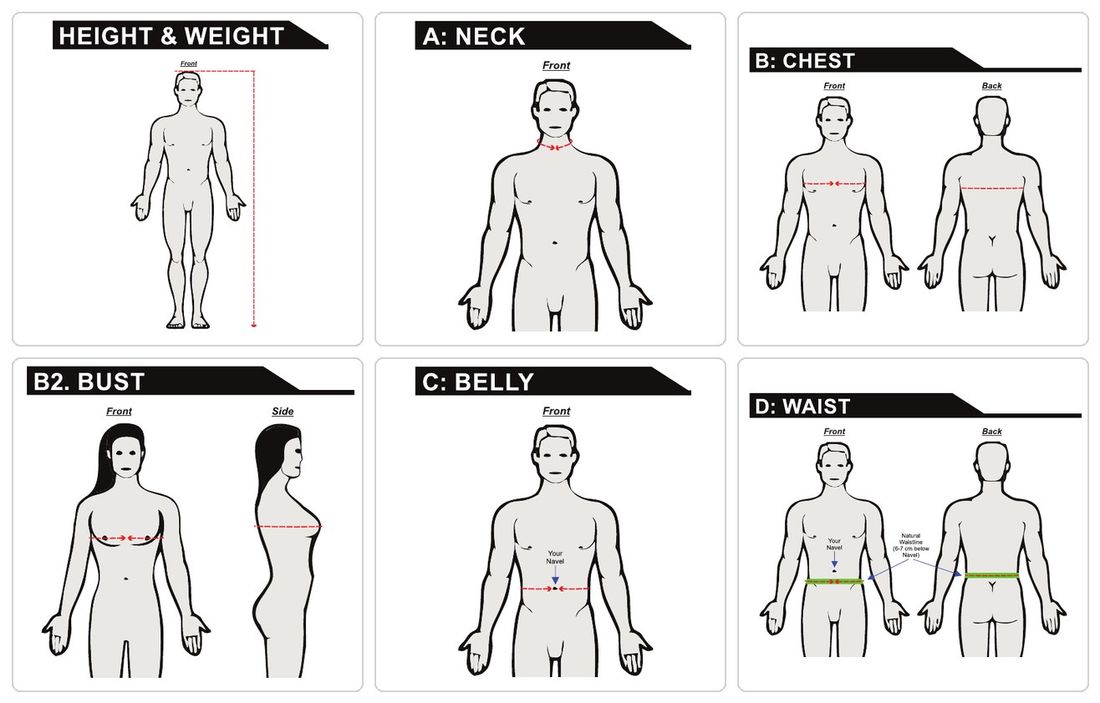
Take them in this order, standing straight and relaxed, and write each one on the form. The letters match the diagrams on the form.
Body
| Ref | Measurement | How to measure |
|---|---|---|
| Height and weight | Stand against a wall without shoes, rest a pencil flat on your head, mark the wall and measure from the floor to the mark. | |
| A | Neck | Around your neck, tape horizontal. |
| B | Chest | Around the widest part of your chest, just under your armpits. |
| B2 | Bust (women only) | Around the widest part of your bust. |
| C | Belly | Around your belly at your navel, tape horizontal. |
| D | Waist | Around your natural waistline, about 6 to 7 cm below your navel. Tie a band here and leave it on: K, Q and T start from it. |
Arms and shoulders
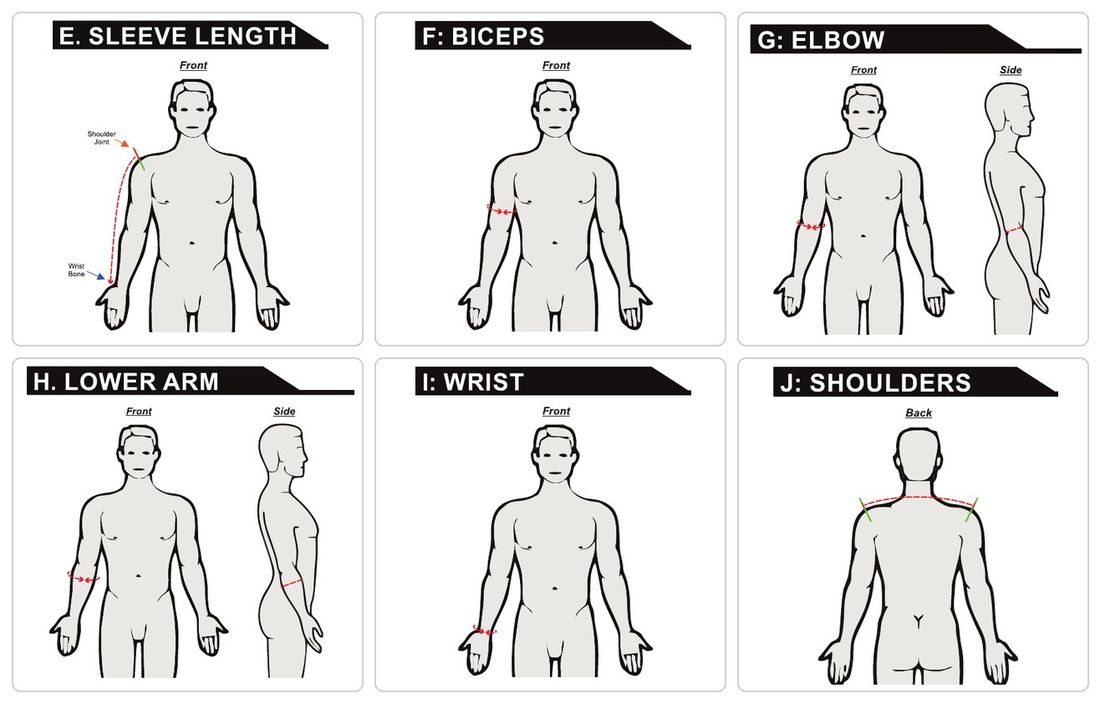
| Ref | Measurement | How to measure |
|---|---|---|
| E | Sleeve length | From the outer edge of your shoulder joint to your wrist bone. Mark the shoulder joint: J starts from it. |
| F | Biceps | Around the widest part of your upper arm, arm straight. |
| G | Elbow | Around the centre of your elbow joint, arm straight. |
| H | Lower arm | Around the widest part of your forearm, just below the elbow. |
| I | Wrist | Around your wrist bone, arm straight. |
| J | Shoulders | Across your back over the tops of your shoulders, from one shoulder mark to the other. |
Hips and legs
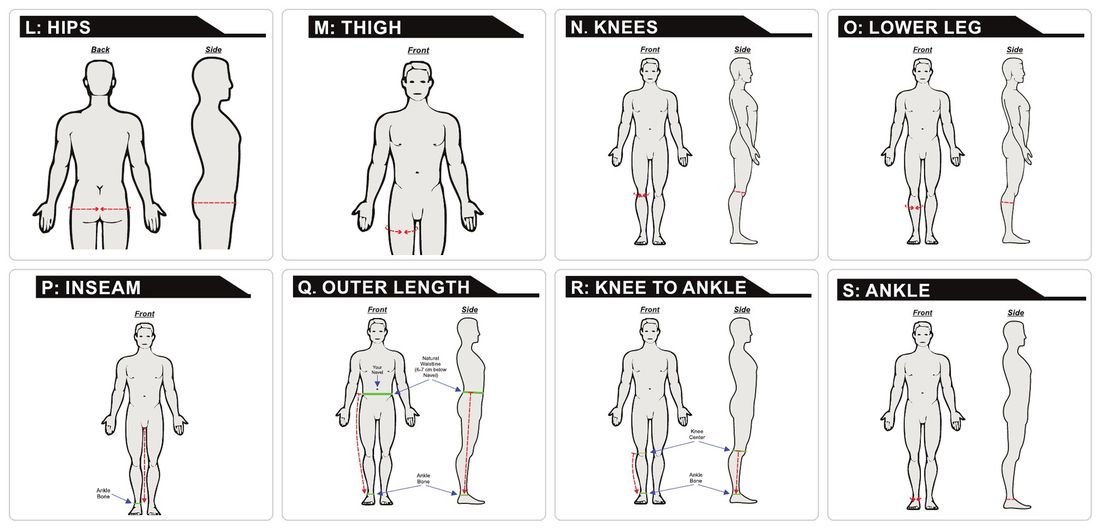
| Ref | Measurement | How to measure |
|---|---|---|
| L | Hips | Around the widest part of your seat, tape horizontal. |
| M | Thigh | Around the widest part of your thigh, about 7 to 8 cm below the crotch. |
| N | Knee | Around the centre of your knee. |
| O | Lower leg | Around the widest part of your calf. |
| P | Inseam | From your crotch to your ankle bone, standing straight. |
| Q | Outer length | Down the outside of your leg from your waistband to your ankle bone. |
| R | Knee to ankle | From the centre of your knee (not the top or bottom) to your ankle bone. |
| S | Ankle | Around your ankle, just above the ankle bone. |
Back length, Shape-J and gloves
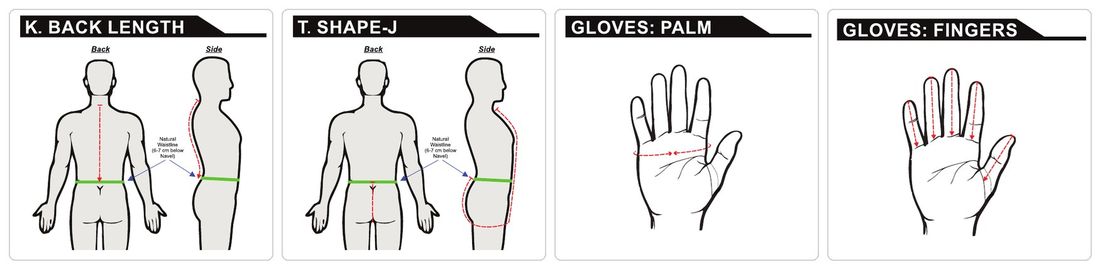
| Ref | Measurement | How to measure |
|---|---|---|
| K | Back length | From the neck joint at the top of your back down to your waistband. No back protector. |
| T | Shape-J | From the waistband at your back, down and under your crotch, then up the front to the neck joint. No back protector; tape neither loose nor tight. |
| Gloves: palm | Around the widest part of your palm at the knuckles, tape snug. | |
| Gloves: fingers | The length of each finger and your thumb, from tip to base. |
Shape-J (T) is the one most people haven't taken before. It's how we get the body length of a one-piece suit right, so take your time with it and ask us if you're unsure.
Common mistakes
- Using another brand's size. Sizes vary between makers. Always measure rather than ordering "a large".
- Measuring over thick clothes. A jumper can add an inch or more to your chest.
- Adding a bit extra "to be safe". Give your true measurements; we allow for movement and padding when we cut.
- Forgetting the riding position. Race leathers are cut for a crouched position, so they can feel short in the body when you stand. That's normal.
Not ordering custom?
For our standard suits, jackets and trousers, the same chest, waist and inside leg measurements work with our Size Guide. If you fall between two sizes, choose the larger one.
Ready to start?
Download the measurement form, then send it with your design ideas through our Custom Leathers page. If anything is unclear, contact us or call 07732 331791 before you measure.
Related Products